

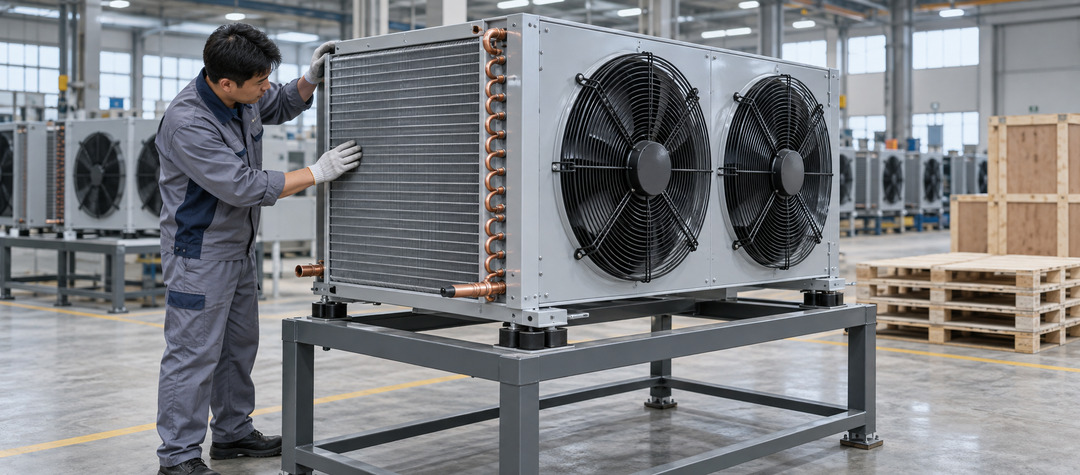
Choosing a refrigeration equipment supplier for an international project requires weighing far more variables at once than a domestic purchase does. Customs regulations, the target country's technical standards, logistics timelines, and language barriers all set export-focused supplier evaluation apart from a local one. A poorly chosen partner can disrupt a project timeline, cause unexpected customs delays, or result in a product that does not comply with the target market's regulations. The sections below cover how export-focused supplier selection differs from domestic projects, technical documentation and certification criteria, how to assess production capacity, the influence of logistics and customs processes, the role of multilingual communication, and a practical selection checklist. Reach out to our team to discuss the specific requirements of your international project.
Table Of Contents
- Why Does Supplier Selection For Export Differ From Domestic Projects?
- What Should Be Considered Regarding Technical Documentation And Certification?
- How Should Production Capacity And Delivery Reliability Be Assessed?
- How Do Logistics And Customs Processes Affect Supplier Selection?
- Why Does Multilingual Communication And Technical Support Matter?
- What Does An Export-Focused Supplier Selection Checklist Look Like?
- Frequently Asked Questions
Why Does Supplier Selection For Export Differ From Domestic Projects?
In a domestic refrigeration equipment purchase, the buyer can usually visit the supplier, inspect the product on site, and reach out in person quickly if an issue arises. In a cross-border project, that direct contact largely disappears; decisions end up relying on documentation, references, and remote communication. This gap calls for a far more rigorous risk assessment in export projects.
The target country's own technical standards, customs regulations, and in some cases local language requirements also come into play. A supplier being reliable in the domestic market does not automatically mean it can manage an international delivery process just as smoothly — export experience should be treated as a distinct competency. Factoring in project budget, delivery-time pressure, and the difficulty of finding an alternative supplier mid-project, taking care with supplier selection early on can prevent costly disruptions further down the line.
What Should Be Considered Regarding Technical Documentation And Certification?
In export projects, documents demonstrating a product's compliance with the target market's regulations sit at the center of the purchasing decision. Key elements to evaluate include:
- CE marking and Declaration of Conformity: For projects destined for Europe, it should be clarified whether these documents fully cover the product group in question.
- Quality management system certification: Suppliers holding an internationally recognized certification such as ISO 9001 offer additional assurance of consistent production.
- Material test reports: Requesting test documents showing material strength is advisable, particularly for pressurized components.
- Product technical file: A detailed technical file covering the capacity calculation method, applicable standards, and design parameters should be available to share.
The currency and scope of documents matter as much as their existence. A certificate may have expired or may only cover a specific product family, so verifying documents is a step that should not be skipped at the quotation stage. Share your project details with our team to clarify the certification requirements specific to your target market.
How Should Production Capacity And Delivery Reliability Be Assessed?
A supplier's production capacity is not just about fulfilling a single order — it is also about maintaining delivery commitments under unforeseen spikes in demand. The following points can be examined during evaluation:
- Combined series and custom production capacity: A manufacturer able to provide project-based engineering solutions when requirements fall outside the standard catalog offers a flexibility advantage.
- Past project references: Having completed export projects of a similar scale shows the supplier's familiarity with international processes.
- Production facility infrastructure: The scale and technological infrastructure of the facility offer insight into its resilience against demand fluctuations.
- Transparency on delivery time: A reliable supplier should be able to provide a realistic, clear delivery schedule.
A practical way to test delivery reliability is to ask the supplier to share references from past projects of comparable scope. Establishing open communication about production planning and capacity status before placing an order reduces uncertainty at later stages.
How Do Logistics And Customs Processes Affect Supplier Selection?
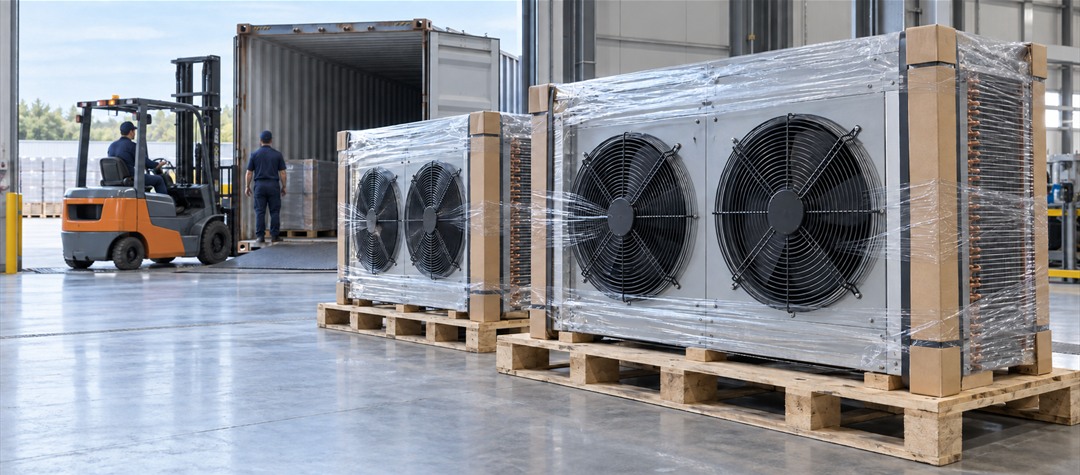
Refrigeration equipment tends to be bulky and, in some cases, includes fragile components, making shipping planning more complex than an ordinary shipment. Logistics-related elements worth examining in supplier evaluation include:
- Packaging standard: Packaging methods suited to long-distance sea or land transport, resistant to moisture and impact, should be used.
- Export documentation experience: Accurately and completely prepared invoices, certificates of origin, and shipping documents prevent customs delays.
- Delivery term options: A supplier's experience with terms such as FOB or CIF helps clarify logistics costs and responsibilities.
- Proximity to a port or border crossing: The production facility's distance to logistics hubs directly affects delivery-time planning.
Most customs delays stem from preventable causes such as missing paperwork or incorrect declarations. Working with an experienced supplier can significantly reduce these risks — reach out to us to align your logistics planning early on.
Why Does Multilingual Communication And Technical Support Matter?
Accurately conveying technical requirements in an international project depends on minimizing the language barrier. A misunderstood technical specification can result in a product built incorrectly or unexpected issues during installation. A supplier able to offer technical support in more than one language reduces the risk of ambiguity, particularly in communication between engineering teams.
Pre-sales technical consultation matters, but so does post-sales support. How quickly a supplier can be reached after an installation issue, in what language support is available, and how long spare parts take to source are all factors that determine the quality of a long-term business relationship. A supplier with multilingual corporate resources can speed up the project process by easing communication with stakeholders across different markets.
What Does An Export-Focused Supplier Selection Checklist Look Like?
A practical checklist that can be used when evaluating a supplier for an export project may include the following items:
- Does the product hold the certification required by the target market (such as CE or ISO 9001)?
- Can the technical file and material test reports be shared upon request?
- Can the supplier provide references from past export projects of comparable scope?
- Is the packaging and shipping method suited to long-distance transport?
- Does the supplier have clear experience and process for preparing customs paperwork?
- Is technical support available in the target market's language or a shared working language?
- Is there a commitment to post-installation maintenance and spare parts support?
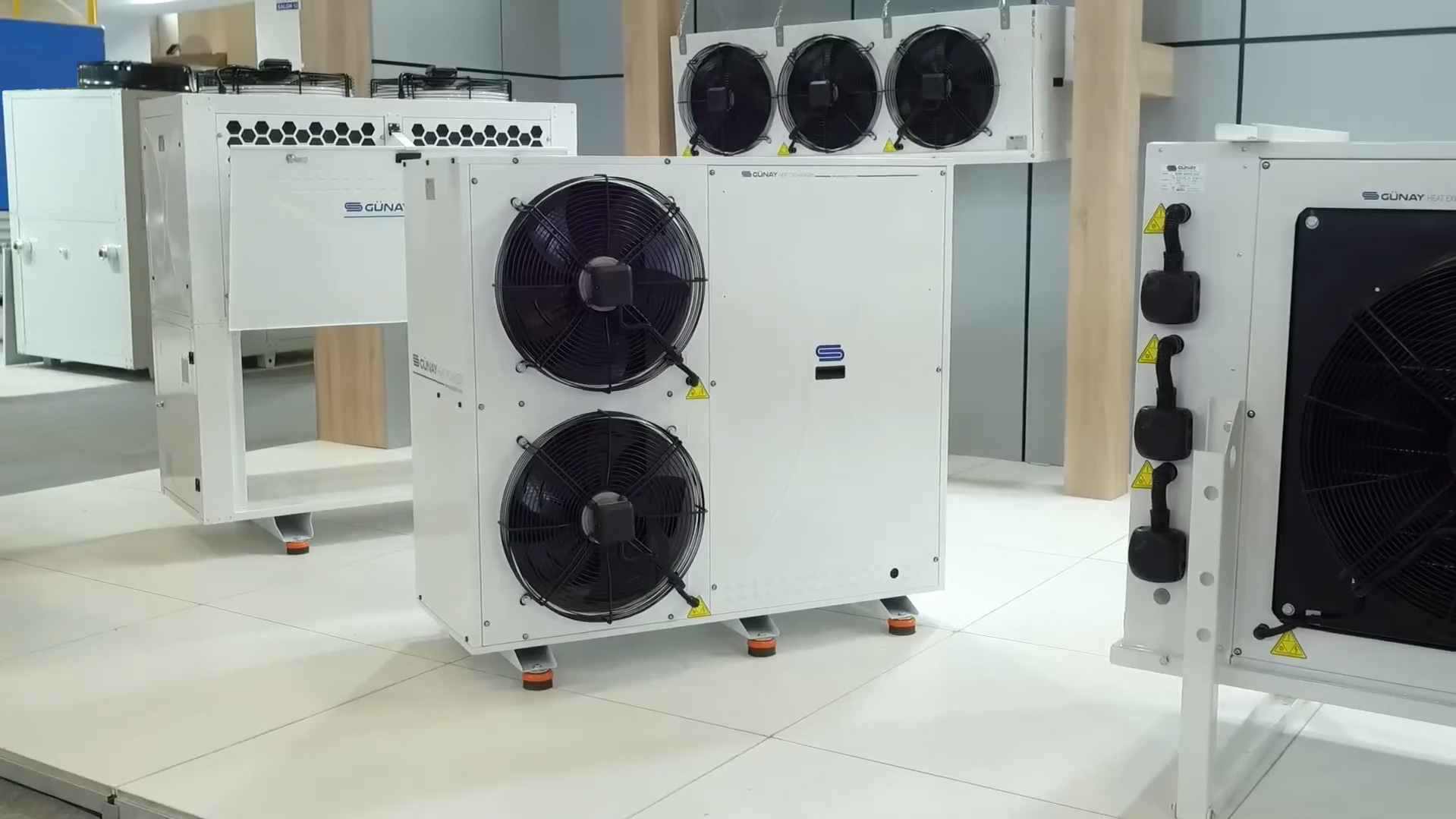
Günay Soğutma offers a supplier profile worth considering for international projects, backed by an ISO 9001:2015-certified production infrastructure, CE-marked product lines, and corporate support available in Turkish, English, and Arabic. Share your export project's requirements with our team to request a project-specific assessment.
Frequently Asked Questions
What Are The Most Common Causes Of Delay In Export Projects?
Missing or incorrect customs paperwork, uncertainty in production capacity planning, and disruptions in shipping bookings are among the most common causes of delay.
How Can I Verify That A Supplier Holds CE Marking?
You can request a copy of the Declaration of Conformity and the related technical file from the supplier to check whether it covers your specific product group.
Is Custom Manufacturing Needed For A Small-Scale Export Order?
Not always; standard catalog models can be sufficient for many projects. Custom manufacturing can be considered for projects with non-standard capacity or installation requirements.
Why Does The Communication Language With A Supplier Matter?
Accurately conveying technical specifications reduces the risk of incorrect manufacturing or installation; clarifying a shared communication language from the start speeds up the project process.
What Information Should Be Shared For An Export Quote?
Sharing information such as the product group, capacity requirement, target country, preferred delivery terms, and any specific regulatory requirements helps in preparing an accurate and timely quote.